In addition to my bug-out bags, I have a separate bag dedicated solely to fire-making. Not only can knowing how to make a fire be critical in a survival situation, but it can be a lot of fun!
In this post, we’ll walk through what’s in my fire-making bag and use it to talk about the different components of a fire.
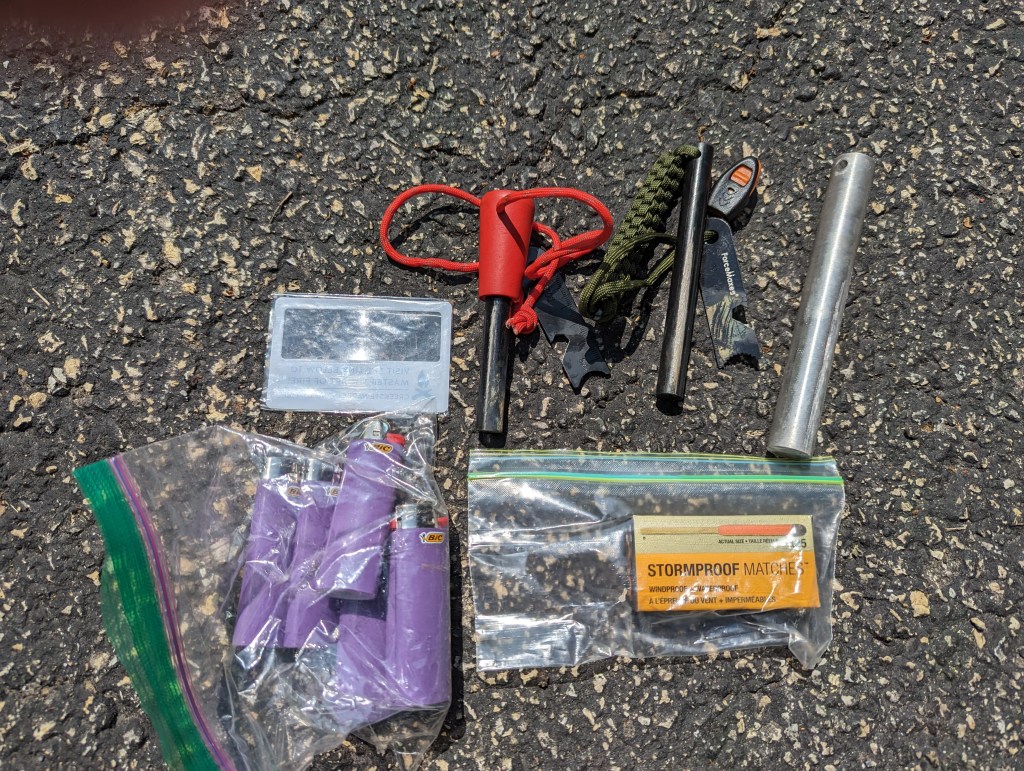
Fire starters
I like to have a variety of fire starters available. A ferro rod and striker is my personal favorite way to start a fire, and you can see two ferro rods and their attached strikers near the top, with the red handle and green lanyard. (For my tips on using a ferro rod, see this post.) I’ve found that a larger rod with an attached handle makes it easier to get a good grip and create the superhot sparks you’ll need, but I’ve also used cheap ferro rods off Amazon.
The silver rod in the top right is magnesium, which you can scrape onto your tinder to give the sparks something to catch on. I also have a small magnifying glass (top left), which I’ve never actually used to start a fire but it’s nice to have the option. Finally, some tried and true fire starters: Bic lighters and stormproof matches. I like purple, so I got a 6-pack of Bic lighters on Amazon – there’s no shame in using a lighter to light your fire if you have one! You might not get the same sense of accomplishment, but I still think it’s pretty cool to gather a tinder bundle and all the kindling you’ll need and then light it with a lighter.
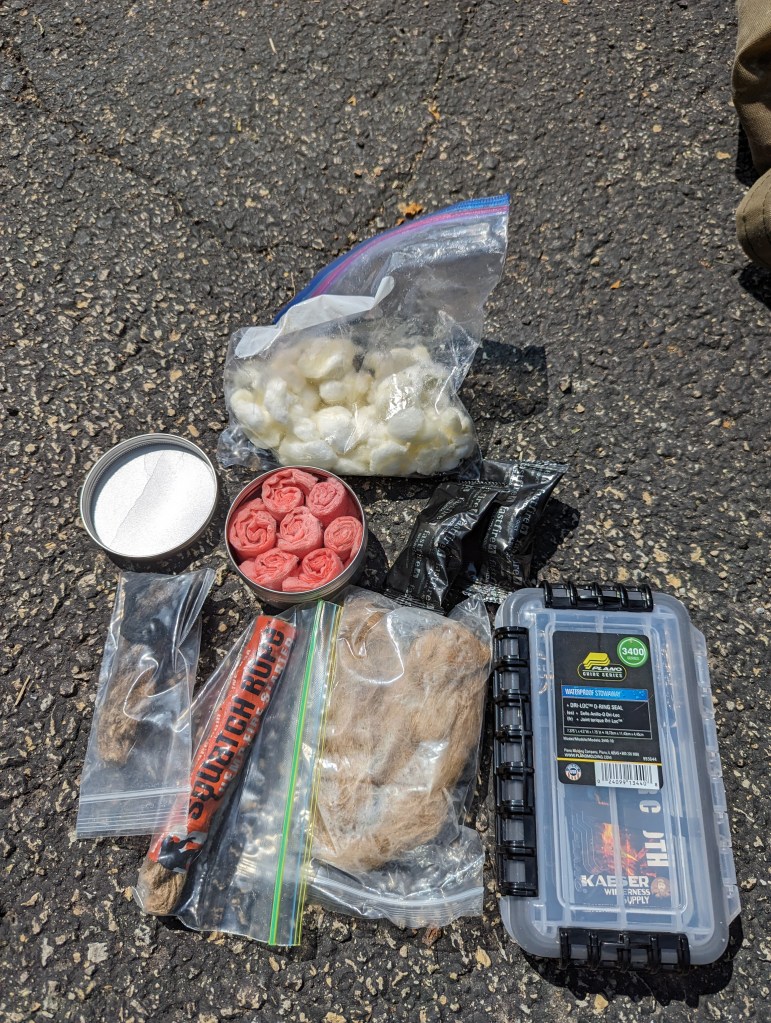
Tinder options
When you’re building your fire, tinder might be the most important part. They’re all important, but tinder is what’s going to ultimately catch a spark and turn it into flame.
Tinder is all about surface area. It should be something you can “fluff.” The more surface area, the more likely it is to catch. My fire-making bag is full of different tinder options, and I practice with all of them.
Time out: I used an important word there, “practice.” With fire-making as with all survival skills, it’s important to practice regularly so that when you’re put to the test, you can perform. Luckily I find fire-making really fun, so it’s a joy to sit in the driveway or around the fire pit, lighting little fires and seeing which tinder works the best!
Let’s take the picture from the top down. At the top, you can see my favorite tinder material: cotton balls that have petroleum jelly (Vaseline) worked into them. When I teach people how to make fire with a ferro rod, this is what I use – I lovingly smoosh Vaseline into a cotton ball for each student! It lights up like a dream, sometimes on the very first spark I throw, and one of these will stay lit for a few minutes, which gives you time to add tiny sticks and start building your fire. The cotton ball is nice and fuzzy, good tinder quality, and the Vaseline makes the flame last longer.
Below that are a couple of commercial tinder options. The pink ones, I got in a fire-making kit that I bought from Creek Stewart. They have a sweet name: Dragon Tongue. And they catch sparks really nicely. The ones in little black bags are called Fast Fire, by a company called Solkoa. You can cut off a little piece and use however much you need. It burns for a long time, but it’s a little trickier to get the fire started than say with a cotton ball. Confession, I usually end up using a lighter to light those instead of a ferro rod.
Below that are several pieces of cordage. Cordage makes good tinder because you can fluff it – separate the individual strands and untwist until you have a nice fluffy bundle. I like to cut off little pieces and take the time to untwist them. I can get it to catch with a spark from a ferro rod. The one that looks like a piece of poop on the left is actually two items from that Creek Stewart fire pack, a hunk of waxed jute that you can cut up and floof, and a piece of charred rope. I haven’t lit any of the charred rope up just yet because I’m trying to save it and I don’t know how to make my own without risking burning it up.
Next to that, we have a Squatch Rope, which I bought at our local outdoors store. It’s made from hemp and works similarly to the jute (you cut off a chunk and fluff it up). The jute and hemp are supposed to work in any weather, wet or dry, which makes them super valuable parts of your kit. And to the right of the Squatch Rope is some natural fiber that also lights up like a dream. It doesn’t last as long as a Vaseline-soaked cotton ball, so you’d better have your little sticks ready to go!
Finally, in a waterproof box I keep some more Fast Fire cubes and a little pack of char cloth. Char cloth is great for catching a spark, and then you can blow the spark into a flame in a tinder bundle of dead grass or whatever is on hand. The hardcore survivalists will laugh at me, but I actually bought a little pack online – I heard once from an expert how to make it, but it’s not a skill I’ve practiced.
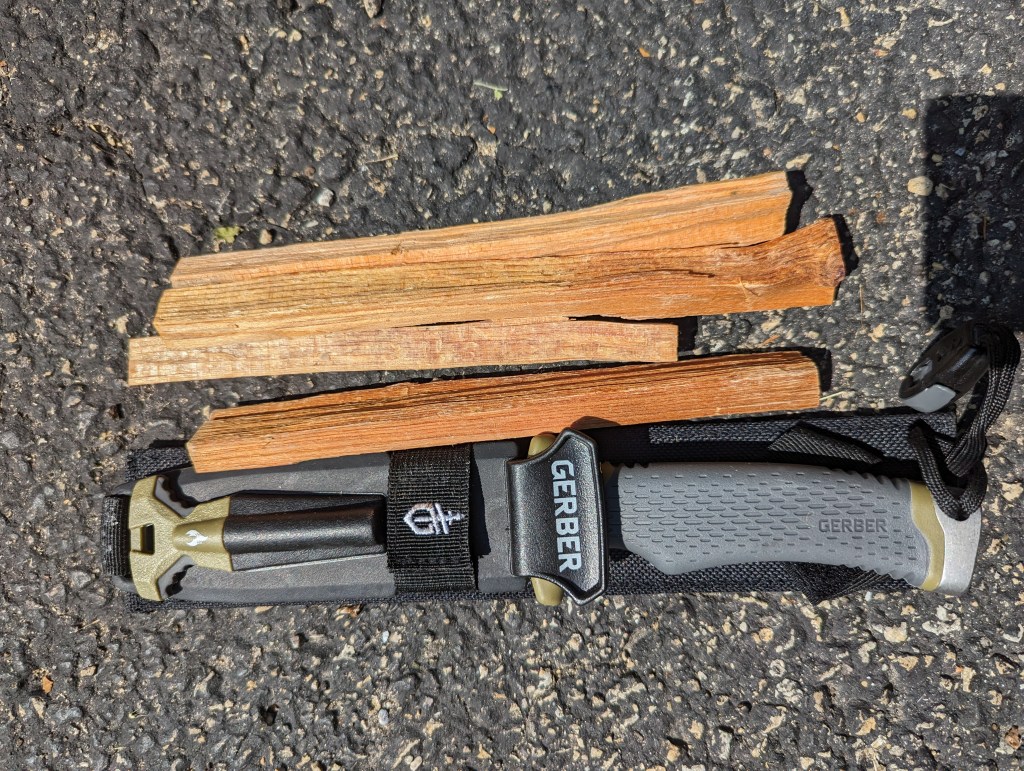
Kindling and a good knife
After you have your tinder ablaze, you’ll need something to help you transition to larger logs. That’s where kindling comes in. I keep a few sticks of fatwood in my fire bag, which is resinous wood from the heart of a dead pine tree. Bonus: it makes your fire bag smell great! Even better: it loves to catch on fire! (Secret bonus: if you have cats, they’ll be fascinated with the smell and jump in the box!)
When I’m making “normal” campfires, I like to include a little fatwood log cabin in the middle, again to make that transition from tinder to larger pieces of kindling.
Then I of course have a knife in the bag, for helping with everything from shaving the fatwood to cutting off pieces of waxed rope. This one from Gerber even has a bonus little ferro rod attached.

Kit for teaching fire-making
This last picture is my teaching kit: 15 ferro rods and strikers, and 30 cotton balls soaked with Vaseline. That way people can buddy up and I can teach a class of 30 people how to make fire. I just got some cheap ferro rods and strikers on Amazon, and of course I worked the Vaseline into the cotton balls myself because this is what I love to do and I think it’s a really cool hobby.
Well, that’s what’s in my fire-making kit! Now if you’ll excuse me, I’m feeling the need to make some sparks fly.


 The Friendly Prepper
Leave a comment